Nearshore staffing services reduce costs for sales-focused companies by eliminating the full stack of expenses that make scaling a U.S. sales operation expensive, not just the salary gap, but the recruiting fees, the ramp time, the turnover cycles, and the hidden pipeline cost that every unfilled or underperforming sales role creates.
The salary comparison is the most visible number. It is not the most important one. Connect2BPO has been building nearshore sales operations teams for U.S. companies in Colombia since 2016. This guide breaks down every cost reduction lever that nearshore staffing delivers for sales-focused companies, and why the total savings are consistently larger than the salary differential suggests.

The True Cost of a U.S. Sales Operations Hire That Nobody Adds Up
Before understanding how nearshore staffing reduces costs, it is worth establishing what a U.S. sales operations hire actually costs — fully loaded, from open role to productive contributor.
Base salary is the number everyone starts with. For a U.S.-based SDR, customer service representative, CRM manager, or sales support coordinator, base salaries in 2026 run from the mid-$40,000s to the low-$80,000s depending on market and seniority.
Employer-side payroll taxes and benefits add approximately 20–30% on top of base salary. Social Security, Medicare, federal and state unemployment taxes, health insurance contributions, 401(k) matching, and paid leave entitlements are not optional — they are structural costs of U.S. employment that are invisible in the headline salary figure but very real on the P&L.
Recruiting fees for a sales operations hire through a domestic staffing agency typically run 15–25% of first-year salary. For a $55,000 SDR role, that is $8,250–$13,750 paid before the hire makes their first call. Internal recruiting costs [job board fees, recruiter time, interview cycles] add further overhead even when no agency is involved.
Ramp time is the cost most companies fail to account for. A new U.S. SDR typically takes 60–90 days to reach full productivity. A CRM administrator may take 30–60 days to learn the client’s data architecture well enough to maintain it accurately. During that period, the company is paying full salary for partial output.
Turnover compounds all of the above. U.S. SDR turnover rates run among the highest of any sales role — many companies cycle through SDRs every 12–18 months. Each turnover event restarts the recruiting fee, the ramp time, and the productivity gap — while the pipeline continues to need coverage that the absent rep was not providing.
How Nearshore Staffing Eliminates Each Cost Layer
The Salary Gap: 60–70% Savings on Base Compensation
The most visible cost reduction is the salary differential between U.S. and Colombian professionals in sales operations roles. Colombian bilingual sales professionals [SDRs, CRM managers, sales support coordinators, lead qualifiers] earn 60–70% less than U.S. equivalents for comparable functions and seniority.
That differential is not a quality compromise. It reflects the cost of living in Colombia, the structure of the Colombian professional labor market, and the competitive compensation levels that attract top bilingual talent in Barranquilla, Bogotá, and Medellín. Colombian professionals earning competitive local salaries are earning well — and they are earning significantly less in U.S. dollar terms than domestic equivalents.
For sales-focused companies outsourcing through Connect2BPO’s NetSourcing model, the salary savings are fully transparent: clients see exactly what the Colombian professional earns, with no hidden margin built into the talent cost.
Employer Costs: A Fundamentally Different Structure
Colombian statutory employment costs are structured differently from U.S. employer obligations — and for most sales-focused companies, the total employer-side cost is lower even with full statutory benefits included.
Colombian employment law requires specific contributions for social security, health insurance, pension, professional risk insurance, and family compensation funds. These are real costs — but they are structured into the employment model from the start, with no ambiguity about what is owed. Connect2BPO’s Employer of Record service manages all Colombian statutory costs directly, bundled into the engagement structure with full transparency.
The absence of U.S.-equivalent benefit expectations — health insurance premiums that have risen sharply in recent years, 401(k) matching obligations, and the soft benefits that U.S. sales hires increasingly negotiate as standard — means the total employer cost differential is wider than the salary gap alone suggests.
Recruiting Fees: Eliminated or Dramatically Reduced
Connect2BPO maintains active pipelines of vetted bilingual Colombian sales professionals across every function it staffs. For most sales operations roles [SDRs, CRM managers, virtual assistants, sales support coordinators] candidates are sourced from existing pipelines rather than initiated from a cold search.
The recruiting fee model that drives 15–25% first-year salary charges in domestic U.S. staffing does not apply to the Connect2BPO engagement structure. The NetSourcing model covers talent acquisition within the management fee, which is separate from and transparent against the talent’s net salary.
For a sales-focused company that hires five nearshore professionals per year with an average U.S. recruiting fee of $10,000 per hire, eliminating those fees represents $50,000 in direct savings before the salary differential is even counted.
Ramp Time: Compressed by Operational Infrastructure
Nearshore professionals placed through Connect2BPO onboard into a structured environment — defined SOPs, peer accountability within a minimum five-person team, and management oversight that does not depend entirely on the U.S. client’s bandwidth.
That infrastructure compresses ramp time for sales operations roles. A Colombian SDR onboarding into an established nearshore team with defined call scripts, CRM access protocols, and a team lead who can answer questions in real time reaches productive output faster than an isolated placement with no surrounding support.
Turnover Cost: Reduced by Retention Investment and Formal Employment
Turnover is the silent budget killer in U.S. sales operations. Each departing SDR or sales support professional takes institutional knowledge, client relationship familiarity, and pipeline context with them; and the replacement cycle restarts every cost described above.
Nearshore turnover in a well-structured engagement runs significantly lower than U.S. SDR turnover for structural reasons. Colombian professionals formally employed through an EOR model [with stable contracts, full statutory benefits, competitive local compensation, and professional development investment ] have strong incentives for tenure that informal contractor arrangements or platform-based gig placements cannot provide.
Connect2BPO’s retention approach for sales operations teams includes compensation benchmarked to the bilingual Colombian professional market, formal EOR employment from day one, professional development pathways, and direct recognition structures that keep Colombian team members engaged with their U.S. clients over time. The result is average tenure that protects the institutional knowledge and operational continuity that make a nearshore sales team genuinely valuable.
Understanding why companies struggle to build reliable nearshore staffing teams includes understanding that turnover is the largest hidden cost in poorly structured nearshore engagements; and that the structural choices made at the start of an engagement determine whether retention works.
Pipeline Cost: The Savings That Never Appear on a Budget Line
For sales-focused companies, the most significant cost of a slow or failed hire is not the recruiting fee or the ramp time. It is the pipeline that did not get worked, the leads that did not get followed up, and the opportunities that aged out while the role was being filled or the new hire was ramping.
A nearshore SDR team operational in two to four weeks covers pipeline that a domestic hiring cycle [45–90 days to hire, 60–90 days to ramp] leaves unworked for four to six months. At any reasonable assumption about SDR productivity and average deal size, that pipeline coverage has a dollar value that dwarfs the salary differential between domestic and nearshore compensation.
This is the cost reduction that never appears on a P&L comparison but that sales leaders who have built nearshore teams consistently identify as the highest-value element of the model. Speed to coverage, not just cost per hire, is the metric that matters.
The Full Cost Comparison: Domestic vs. Nearshore Sales Operations
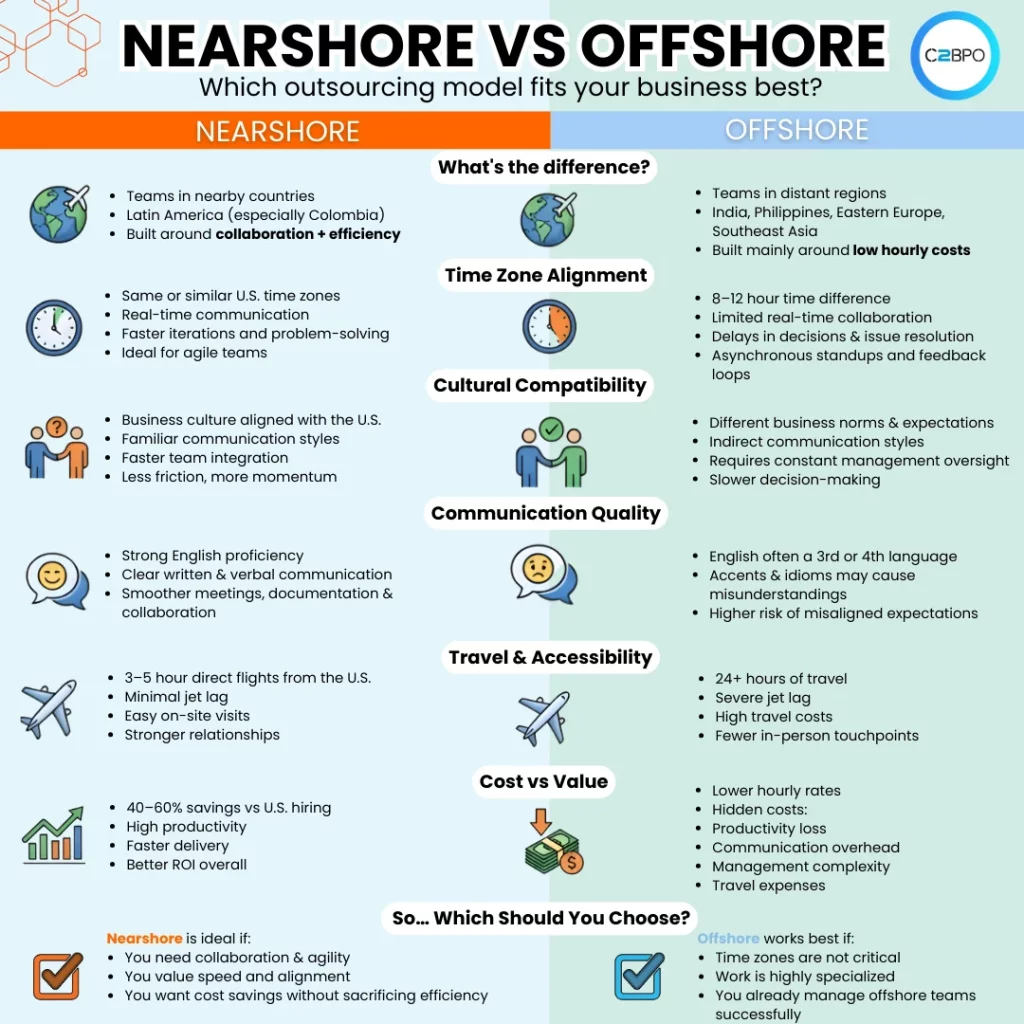
When all cost layers are in the calculation — salary, employer costs, recruiting fees, ramp time, turnover, and pipeline coverage speed — the total cost advantage of nearshore staffing for sales-focused companies is consistently larger than the headline salary comparison suggests.
<cite index=”17-1″>Total employment costs for equivalent roles can be 30–50% lower than hiring domestically even after partner fees, benefits, and equipment. Savings increase further by reducing recruitment fees, which in the U.S. often run 20–30% of first-year salaries.</cite> For sales operations roles specifically, where turnover rates are high and ramp periods are significant, the total savings run at the higher end of that range — and compound as the team scales.
For a sales-focused company building a five-person nearshore sales operations team covering SDR outreach, CRM management, and sales support coordination, the annual fully-loaded cost advantage versus a domestic equivalent team typically falls in the range of 50–65% — a savings that translates directly into either margin improvement or the ability to invest that differential back into additional headcount, expanded pipeline coverage, or sales technology.
Which Sales Operations Functions Deliver the Highest Cost Reduction Nearshore
Not every sales function delivers equivalent savings. The functions where nearshore staffing delivers the highest cost reduction for sales-focused companies are those where:
- The role is process-defined and measurable, reducing ramp time and quality risk
- The function operates during U.S. business hours, making time zone alignment a direct productivity enabler
- The U.S. domestic salary for the equivalent role is high relative to the Colombian market rate
On all three criteria, the highest-value nearshore functions for sales-focused companies are:
Sales Development Representatives: High domestic salary, high turnover, defined measurable outputs, fully time-zone dependent. The cost reduction is 60–70% on base compensation, with additional savings from lower recruiting fees and better retention.
CRM Operations and Data Management: Process-defined, accuracy-measurable, and fully operable in shared U.S. hours. The domestic salary for a CRM administrator or data specialist is high relative to the function’s strategic value; the nearshore equivalent delivers the same output at a fraction of the cost.
Virtual Assistants and Sales Support Coordinators: The functions most commonly handled by overloaded account executives or sales managers who should be selling. Moving these functions nearshore recaptures that time at a cost that pays back within weeks.
Lead Qualification and Research: High volume, defined criteria, and directly pipeline-connected. A nearshore lead qualification team that processes inbound leads faster and more consistently than a stretched domestic team has a direct revenue impact, not just a cost reduction.
Building a Cost-Efficient Nearshore Sales Operations Team
The companies that achieve the highest cost reduction through nearshore staffing for sales operations are those that treat the engagement as an operational model decision; not a procurement choice.
They define the functions, the SLAs, and the performance criteria before the team starts. They onboard nearshore professionals with the same rigor as any core team member. They invest in retention from day one through formal EOR employment and competitive local compensation. And they partner with a provider [like Connect2BPO] that manages the compliance, HR, and payroll infrastructure so the U.S. sales leadership can focus on revenue, not administration.
Connect2BPO provides nearshore sales operations staffing, back-office support, and virtual assistance for U.S. sales-focused companies, with full Employer of Record, payroll, and HR compliance infrastructure included. The NetSourcing model ensures full pricing transparency — every client knows exactly what the talent earns and what the management infrastructure costs.
Contact Connect2BPO to receive a structured cost comparison for your specific sales operations requirements.
Frequently Asked Questions
How do nearshore staffing services reduce costs for sales-focused companies?
Nearshore staffing reduces costs for sales-focused companies across five layers: base salary savings of 60–70% versus U.S. equivalents, lower employer-side statutory costs, elimination of domestic recruiting fees, compressed ramp time through operational infrastructure, and lower turnover rates through formal EOR employment and retention investment. The total cost advantage when all layers are included consistently runs 50–65% for sales operations roles.
Which nearshore staffing services do U.S. sales teams use?
U.S. sales teams most commonly outsource nearshore: SDR outbound prospecting, CRM operations and data management, lead qualification and research, sales support coordination, digital outreach execution, sales reporting and analytics, and customer success support. Connect2BPO’s complete guide to which nearshore staffing services U.S. sales teams use covers all seven functions with specific applications for sales-focused companies.
What nearshore staffing services work best for SaaS sales companies?
SaaS sales companies achieve the highest nearshore ROI from SDR outbound, CRM operations, lead qualification, and customer success support — the four functions where SaaS revenue teams face the most capacity pressure as they scale. Connect2BPO’s complete guide to what nearshore staffing services work best for SaaS sales companies covers the SaaS-specific applications in detail.
How to compare nearshore staffing agencies for sales operations roles?
Compare providers on six criteria: sales-specific vetting protocols, Colombia talent pipeline depth, employment structure and EOR capability, post-placement management infrastructure, minimum team size and scalability, and vertical industry experience. Connect2BPO’s complete framework for how to compare nearshore staffing agencies for sales operations roles walks through each criterion with specific questions to ask every provider.
Why do companies struggle to build reliable nearshore staffing teams?
The core issue is treating nearshore staffing as a sourcing problem rather than an operating model problem. Connect2BPO’s breakdown of why companies struggle to build reliable nearshore staffing teams covers the ten most common failure patterns — including the specific ones that affect sales operations teams most directly.
What is the best nearshore staffing solution for BPO teams?
The best nearshore BPO staffing solution combines managed talent, full EOR employment compliance, and transparent pricing. Connect2BPO’s complete guide to the best nearshore staffing solution for BPO teams covers the full evaluation framework with Connect2BPO’s Colombia-only model as the operational example.