
Discover answers to the most frequently asked questions about staffing, recruitment processes, and how agencies help businesses find qualified talent. Read our staffing FAQ to understand how recruitment and staffing services work, and how they can improve your operational and day-to-day processes.
Understanding the Management Function of Staffing
What is the meaning of staffing?
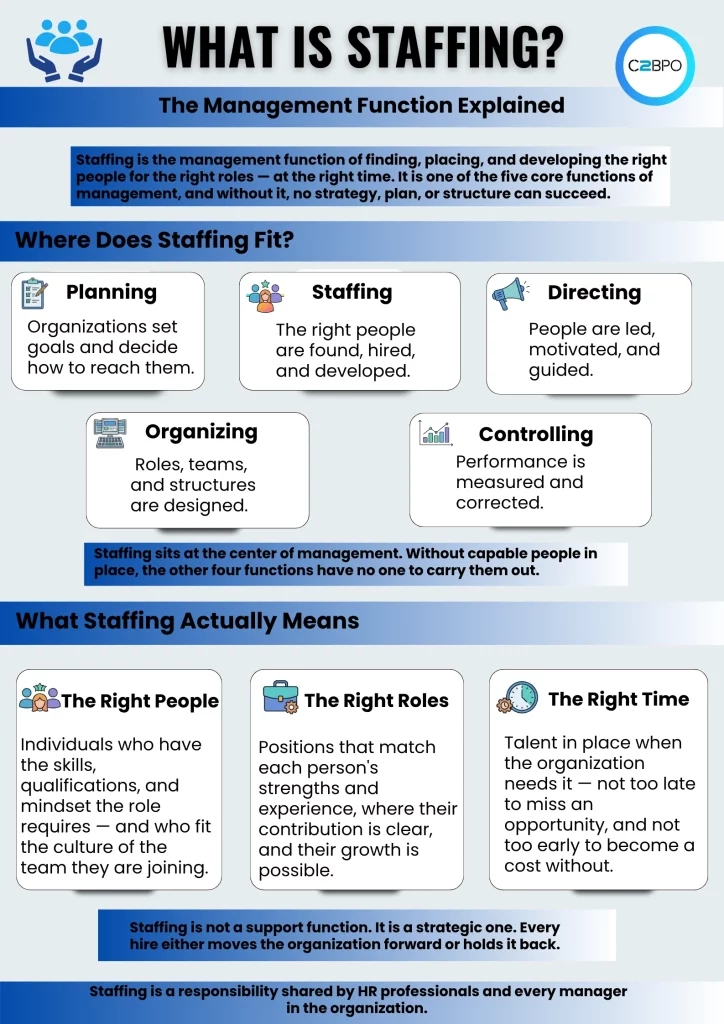
Staffing is the management function concerned with recruiting, selecting, placing, training, developing, appraising, and retaining the right people for the right roles at the right time. In simple terms, it is the process of filling organizational positions with qualified individuals, and then ensuring those individuals have the tools and support to succeed.
At its core, staffing answers a fundamental question every organization faces: Do we have the right people to do the work we need to do? Without an effective staffing process, even the best strategic plans fall apart because there is no capable team to execute them.
What is staffing in management function?
In the classic framework of management theory, organizations are run through five core functions: planning, organizing, staffing, directing, and controlling. Staffing occupies a critical middle position, it comes after the structure has been designed (organizing) and before people are led and motivated (directing).
As a management function, staffing is both a process and a responsibility. It is a process because it follows systematic steps from identifying workforce needs to onboarding new hires. It is a responsibility because managers at every level [not just HR] participate in finding, evaluating, and retaining talent.
Describe the management function of staffing, what does it actually involve?
The staffing management function encompasses a broad range of activities that together ensure an organization is populated by competent, motivated, and well-placed individuals. These include:
- Human Resource Planning: analyzing future needs and gaps in the workforce
- Job Analysis and Design: defining what each role requires in terms of duties and competencies
- Recruitment: attracting a pool of qualified candidates through internal and external channels
- Selection: evaluating candidates through interviews, tests, and assessments to choose the best fit
- Placement and Induction: integrating new hires into the organization and their specific roles
- Training and Development: building the skills and capabilities employees need to grow
- Performance Appraisal: measuring how well employees are doing against expectations
- Compensation and Promotion: rewarding performance and creating career progression pathways
- Separation: managing the end of employment, whether through resignation, retirement, or termination
Each of these steps is interconnected. Weak recruitment undermines selection quality; poor training leads to low performance; inadequate appraisal makes promotion decisions arbitrary.
Is staffing a managerial function?
Yes, unambiguously. Staffing is one of the primary functions of management, recognized as such by foundational management scholars like Koontz and O’Donnell, who were among the first to formalize the five functions of management framework. While HR departments specialize in staffing activities, the function itself is managerial in nature because it directly affects organizational performance and requires decision-making authority.
Every manager [from a team lead to a CEO] exercises a staffing function when they participate in hiring decisions, evaluate their team’s performance, identify training needs, or advocate for a team member’s promotion. Staffing is not just an HR task; it is a leadership responsibility.
Functions and Steps of the Staffing Process
What are the 7 important functions of staffing?
While different authors categorize the functions of staffing in slightly different ways, the seven most widely recognized are:
- Manpower Planning: forecasting how many people with what skills will be needed, and when
- Recruitment: generating a pool of applicants through job postings, networking, referrals, and agencies
- Selection: filtering applicants through a rigorous process to identify the best candidates
- Placement and Orientation: assigning employees to appropriate roles and helping them integrate
- Training and Development: equipping employees with the knowledge and skills to perform and grow
- Performance Appraisal: systematically evaluating employee contributions and identifying gaps
- Promotion, Transfer, and Separation: managing career progression and handling workforce transitions
These seven functions are not isolated; they form a continuous cycle. The insights from performance appraisals, for instance, feed directly back into training plans and future recruitment criteria.
What are the 7 steps of the staffing process?
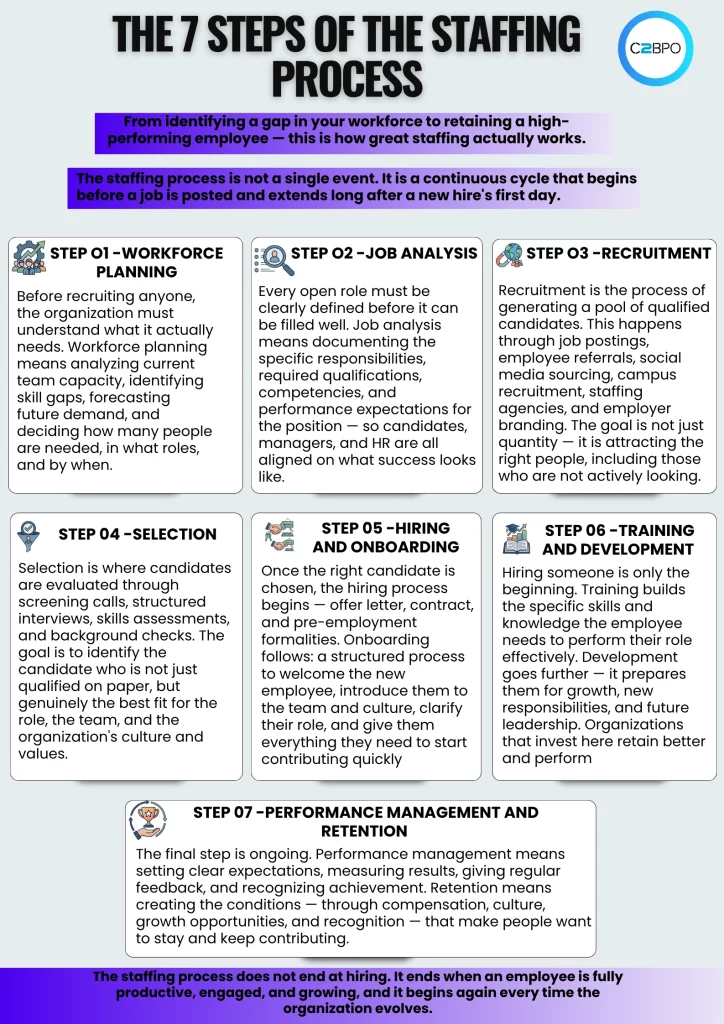
The staffing process follows a logical sequence that begins long before a candidate is interviewed and extends well beyond their first day on the job:
- Workforce Planning: identifying the number and types of positions the organization needs to fill, both now and in the future
- Job Analysis: defining the responsibilities, qualifications, and competencies required for each role
- Recruitment: reaching potential candidates through various sourcing strategies
- Selection: screening, interviewing, testing, and ultimately choosing the right candidate
- Hiring and Onboarding: extending the offer, completing paperwork, and welcoming the new employee into the organization
- Training and Development: building the skills and confidence the employee needs to succeed in their role
- Performance Management and Retention: monitoring performance over time, providing feedback, and taking steps to keep valuable employees engaged
Which of these activities ends the staffing function? We asked our HHRR generalist, who answered, “In many management frameworks, the staffing function formally concludes with placement or induction, the moment a qualified person has been placed in the right role. In a broader and more modern interpretation, however, staffing is an ongoing cycle that never truly ends, because organizations are always evolving, people are always developing, and roles are always changing.”
What activities are involved in the staffing function of HRM?
Human Resource Management operationalizes the staffing function through a wide range of day-to-day activities:
- Writing and publishing job descriptions and job postings
- Sourcing candidates via job boards, social media, campus recruitment, and employee referrals
- Conducting initial screening calls and structured interviews
- Administering skills assessments, psychometric tests, and background checks
- Coordinating offer letters, contracts, and pre-employment verifications
- Running onboarding programs and orientation sessions
- Identifying and delivering training programs to address skill gaps
- Administering performance review processes and 360-degree feedback
- Managing succession planning and internal mobility
- Handling offboarding and exit interviews
Taken together, these activities make staffing one of the most operationally intensive functions in any organization, and one of the most strategically significant.
Staffing vs. HR – Are They the Same?
Is staffing the same as HR?
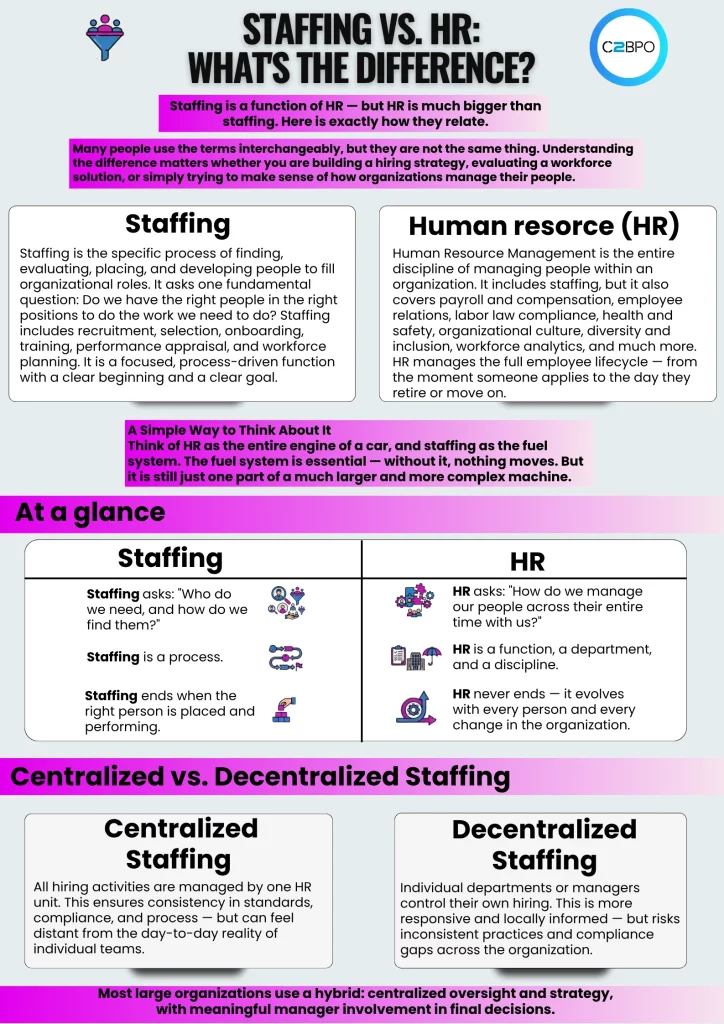
This is a very common point of confusion, and the short answer is: staffing is a function of HR, but HR is much more than staffing.
Human Resource Management is a broad discipline that covers everything related to the employee lifecycle [from recruitment to retirement]. It includes staffing, but also encompasses employee relations, labor law compliance, compensation and benefits administration, organizational culture, health and safety, workforce analytics, and much more.
Staffing, by contrast, refers specifically to the process of identifying, acquiring, and deploying human talent to fill organizational roles. Think of HRM as the entire engine of a car, and staffing as the fuel system, essential, but just one part of a larger whole.
In the context of staffing agencies or workforce solutions companies, “staffing” often refers specifically to the business of placing temporary or contract workers with client organizations. In this industry usage, staffing firms provide a specialized service focused on recruitment and placement, without the full scope of HRM responsibilities that an internal HR team holds.
What is the staffing function of human resource management?
Within HRM, the staffing function is the subset of activities focused on ensuring the organization has the right number of people with the right capabilities in the right positions at the right time. HR professionals who specialize in staffing are typically involved in:
- Talent acquisition strategy: determining where and how to find candidates
- Employer branding: building the organization’s reputation as a desirable place to work
- Recruitment marketing: attracting passive candidates who aren’t actively job hunting
- Selection methodology: designing fair, valid, and legally compliant assessment processes
- Workforce planning: anticipating future skill needs based on business strategy
The staffing function in HRM has grown considerably more sophisticated in recent years, driven by data analytics, AI-powered recruiting tools, and a greater emphasis on candidate experience and diversity, equity, and inclusion.
Is centralized staffing a function of management?
Yes, centralized staffing is a specific organizational model where staffing activities are consolidated in a single HR unit rather than distributed across individual departments or business units. It is very much a management function, and organizations adopt it when they want to ensure consistency in hiring standards, reduce duplication of effort, improve compliance, and achieve economies of scale in recruitment.
In contrast, decentralized staffing gives individual managers or departments more control over their own hiring. Both models have trade-offs: centralized staffing offers uniformity but can feel removed from frontline needs; decentralized staffing is more responsive but can lead to inconsistent practices.
Many larger organizations adopt a hybrid approach, centralizing compliance oversight and strategic workforce planning while allowing departmental managers to participate meaningfully in final hiring decisions.
Staffing Within the Broader Management Framework
Are planning, staffing, and controlling all functions of management?
Yes, planning, staffing, and controlling are three of the five core functions of management in the classical framework. The complete set is:
- Planning: setting organizational goals and determining the best path to achieve them
- Organizing: structuring resources and roles to pursue those goals
- Staffing: ensuring the organization has the human talent needed to do the work
- Directing (or Leading): motivating, guiding, and communicating with the people doing the work
- Controlling: monitoring performance, comparing it against goals, and taking corrective action
These five functions are interdependent. Planning without staffing is a wish list. Controlling without staffing is impossible because you need capable people to monitor and act on performance data. Staffing gives the other management functions their human foundation, it is the function that ensures there are real people capable of executing on everything else the organization plans to do.
What is the staffing management function in relation to organizational performance?
The staffing management function is one of the most direct drivers of organizational performance. Research consistently shows that organizations with strong talent acquisition and development practices outperform their peers in productivity, innovation, and profitability. This is because:
- The right people in the right roles make better decisions, serve customers more effectively, and solve problems more creatively
- Strong staffing practices reduce costly turnover, lowering the financial and cultural disruption that comes with frequent employee exits
- Investing in employee development through training and promotion pathways increases engagement and retention
- Thoughtful performance management ensures that high performers are recognized and supported, while performance gaps are addressed proactively
In a knowledge economy where intellectual capital is often an organization’s greatest competitive advantage, the staffing function is not a support activity — it is a strategic one.
Technology and the Future of Staffing
How do integrated APIs enhance staffing software functionality?
Modern staffing operations run on software, Applicant Tracking Systems (ATS), Human Resource Information Systems (HRIS), payroll platforms, background check services, onboarding tools, and more. The challenge has historically been that these systems often operated in silos, requiring manual data entry and creating fragmented candidate and employee records.
Integrated APIs (Application Programming Interfaces) solve this problem by allowing different software systems to communicate and share data in real-time. For staffing professionals, this integration delivers several powerful benefits:
- Seamless candidate flow: a candidate’s information entered in one system automatically populates across the ATS, scheduling tool, offer management platform, and HRIS
- Faster time-to-hire: eliminating manual handoffs between systems reduces administrative bottlenecks and compresses the hiring timeline
- Richer analytics: when data from sourcing, screening, onboarding, and performance systems is connected, organizations can analyze the full candidate-to-employee journey and identify what predicts success
- Better candidate experience: automated communications, self-service portals, and streamlined onboarding make the process feel professional and organized
- Compliance and auditability: integrated systems create a consistent, documented trail of every step in the hiring process, which is critical for legal compliance and equal opportunity auditing
For staffing agencies in particular, API integration is increasingly a competitive differentiator. Agencies that can integrate seamlessly with client HRIS and payroll platforms offer a faster, more transparent, and lower-friction service. As staffing technology continues to evolve, the ability to connect systems through robust APIs will be foundational to any modern workforce solution.
Skills and Real-World Staffing
What skills are needed for staffing?
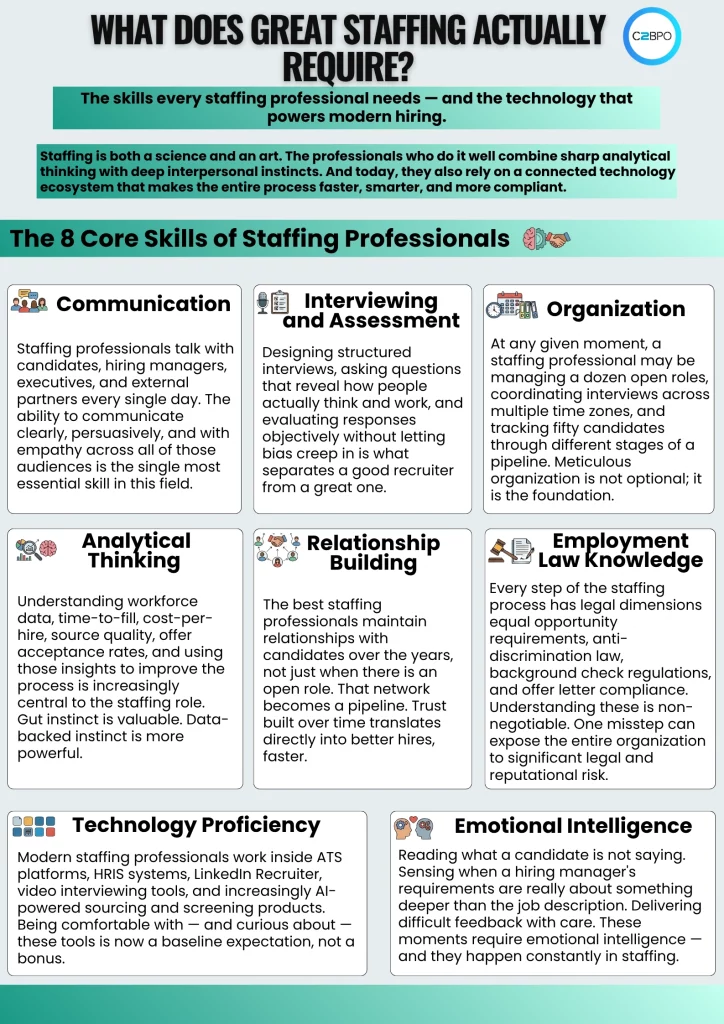
Staffing is both a science and an art. Professionals who excel in this field typically combine analytical capability with strong interpersonal instincts. The most important skills include:
- Communication: staffing professionals interact with candidates, hiring managers, executives, and vendors; clear, persuasive, and empathetic communication is essential at every stage
- Interviewing and Assessment: the ability to design structured interviews, ask probing questions, and objectively evaluate candidate responses separates good from great recruiters
- Organizational Skills: managing multiple open roles simultaneously, coordinating interview schedules, and tracking candidates through different pipeline stages requires meticulous organization
- Analytical Thinking: understanding workforce data, interpreting recruitment metrics (time-to-fill, cost-per-hire, offer acceptance rates), and using insights to improve processes
- Relationship Building: staffing is fundamentally about people; building trust with candidates and hiring managers over time creates competitive sourcing advantages
- Knowledge of Employment Law: understanding equal opportunity legislation, anti-discrimination law, and labor regulations is non-negotiable for compliant staffing practices
- Technology Proficiency: modern staffing professionals must be comfortable with ATS platforms, LinkedIn Recruiter, HRIS systems, and increasingly AI-powered sourcing and screening tools
- Emotional Intelligence: reading between the lines of what a candidate or manager is saying, managing expectations, and delivering difficult feedback with care
Beyond technical skills, the best staffing professionals bring genuine curiosity about people and organizations. Understanding what makes a role challenging, what a team culture feels like, and what a candidate’s long-term aspirations are, these human insights are what ultimately lead to hires that last.
What is real staffing?
“Real staffing” distinguishes genuine, value-driven talent placement from transactional, fill-the-seat hiring. In practice, it means:
- Understanding the hiring manager’s actual needs, not just the job description, but the culture, the team dynamics, and the challenges the new hire will face
- Being honest with candidates about compensation, growth opportunities, work environment, and the realistic day-to-day of the role
- Making placements designed to last, prioritizing long-term fit over quick closes, even when speed is pressured
- Staying engaged after placement, following up with both the candidate and the employer to ensure the transition is going well
For organizations building their own internal staffing capability, the spirit of real staffing means treating every hire as a strategic decision, one that deserves careful thought, rigorous process, and genuine investment in the human being being brought into the organization.
Final Thoughts
Staffing is one of the oldest management concepts and one of the most persistently important. In a world where skills requirements evolve faster than ever, where remote work has expanded the talent pool globally, and where AI is reshaping how we find and evaluate candidates, the fundamentals remain constant: put the right people in the right roles, give them what they need to succeed, and manage their growth thoughtfully.
Whether you are a student learning management theory, an HR professional building a workforce strategy, or a business leader thinking about how technology can improve your hiring process, understanding staffing as a management function gives you a powerful lens for thinking about organizational performance and human potential.