
The way U.S. companies build their teams has fundamentally changed. H-1B visa restrictions are tightening, domestic talent costs are climbing, and the offshore model — built on 10-hour time zone gaps and cultural friction — is losing its appeal. In 2026, the answer for thousands of growth-stage and enterprise companies alike is nearshore outsourcing: building complete, managed remote operations in Latin America that run like an extension of your in-house team.
This guide covers everything you need to know — what nearshore outsourcing actually is, why Colombia has become the preferred destination, how it compares to offshore alternatives, what it costs, and how to build your operation the right way.
What is Nearshoring?
Nearshore outsourcing is the practice of delegating business operations or services to providers in nearby countries, typically within one to three time zones of your headquarters. For U.S. companies, this means Latin America — and specifically Colombia, Mexico, Costa Rica, and Argentina.
Unlike offshoring (partnering with teams in India, the Philippines, or Eastern Europe), nearshore outsourcing prioritizes:
- Time zone alignment — real-time collaboration during shared business hours
- Cultural compatibility — business norms, communication styles, and work ethic that feel familiar
- Geographic proximity — a direct flight away when in-person matters
The result is a team that operates like an in-house department, not like a vendor you email and hope to hear back from tomorrow morning.
What Is Nearshoring vs. Nearshore Outsourcing?
These terms are often used interchangeably, but there is a subtle distinction worth understanding. Nearshoring broadly refers to relocating or extending any business function to a nearby country — including building your own office there. Nearshore outsourcing specifically means partnering with an established provider who already has the infrastructure, talent pipelines, and compliance frameworks in place. You get the benefits of a nearshore team without the capital investment and administrative complexity of setting up a foreign entity.
What Is Nearshore Staff Augmentation?
Nearshore staff augmentation is the most common entry point. You add one or more nearshore professionals directly to your existing team — they use your tools, follow your processes, and report to your managers. It is the fastest way to scale without full outsourcing, and it is a model Connect2BPO has refined since 2016.
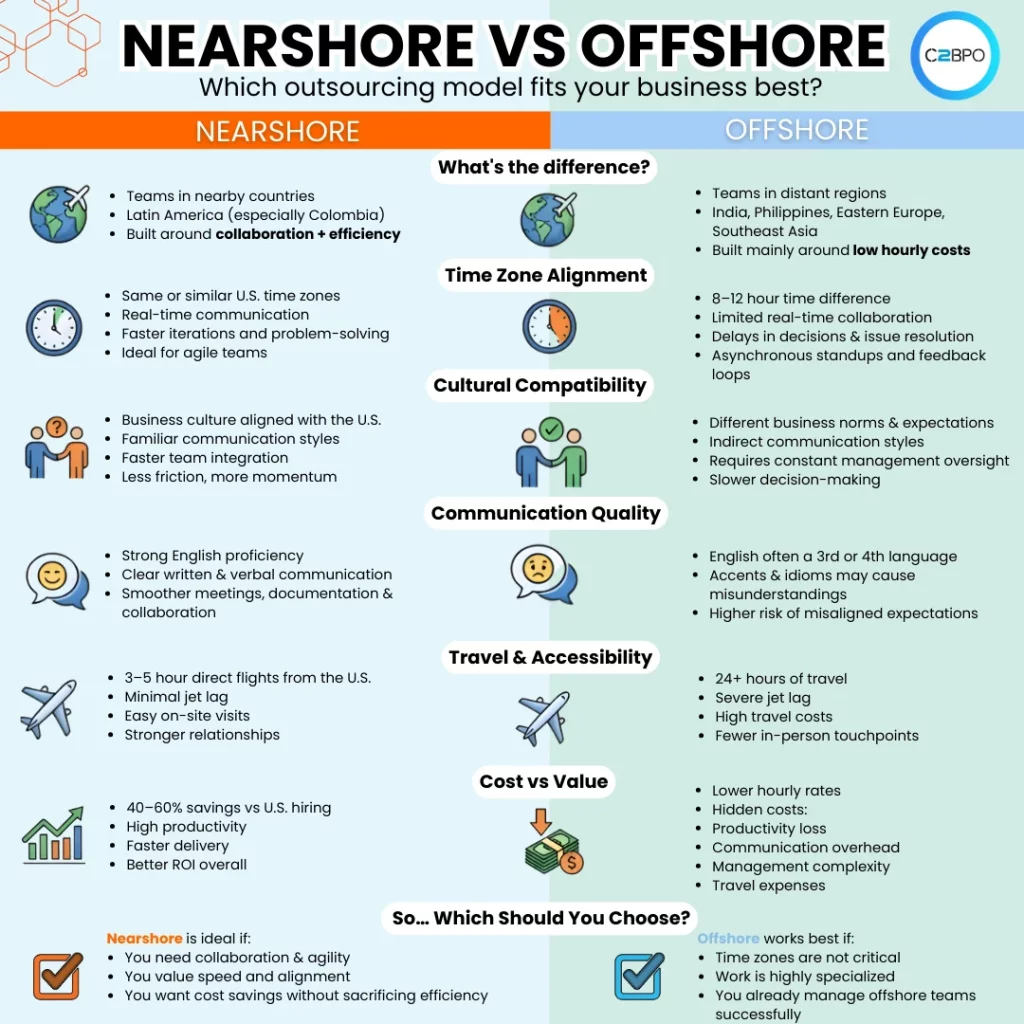
Nearshore vs. Offshore: Why the Model Has Shifted this year
For decades, offshoring dominated the outsourcing conversation. The cost savings were real, and companies accepted the trade-offs: communication delays, cultural friction, quality inconsistency. In 2026, that calculus has changed — and nearshore outsourcing has become the preferred model for most U.S. businesses.
Time Zone: The Collaboration Tax Nobody Budgeted For
Offshore teams in India or the Philippines operate 8–12 hours ahead of U.S. business hours. What looks like a cost advantage on paper creates a hidden operational tax: daily standups become asynchronous updates, urgent issues wait until morning, and iterative work that should take days stretches into weeks.
Nearshore teams in Colombia operate on Eastern or Central Time — the same 9-to-5 as your U.S. team. Questions get answered in minutes. Decisions happen in real time. Projects move faster.
Cultural Alignment: The Intangible That Drives Results
Latin American business culture shares far more DNA with North American practices than Asia or Eastern Europe. Colombian professionals understand American-style directness, customer-centric thinking, and results-driven performance. This is not a generalisation — it is the consistent feedback from U.S. companies who have built nearshore teams in both regions.
Communication Quality
English proficiency among Colombian professionals — particularly in technology, customer service, and business operations — has improved dramatically over the past decade. Universities in Bogotá, Medellín, Barranquilla, and Cali now produce graduates with professional-level English as a standard expectation, not an exception.
The Real Cost Comparison
Offshore appears cheaper on the hourly rate. Nearshore wins on total cost of ownership. When you factor in:
- Productivity losses from time zone misalignment
- Management overhead to bridge communication gaps
- Rework cycles and quality inconsistency
- Travel cost when in-person becomes unavoidable
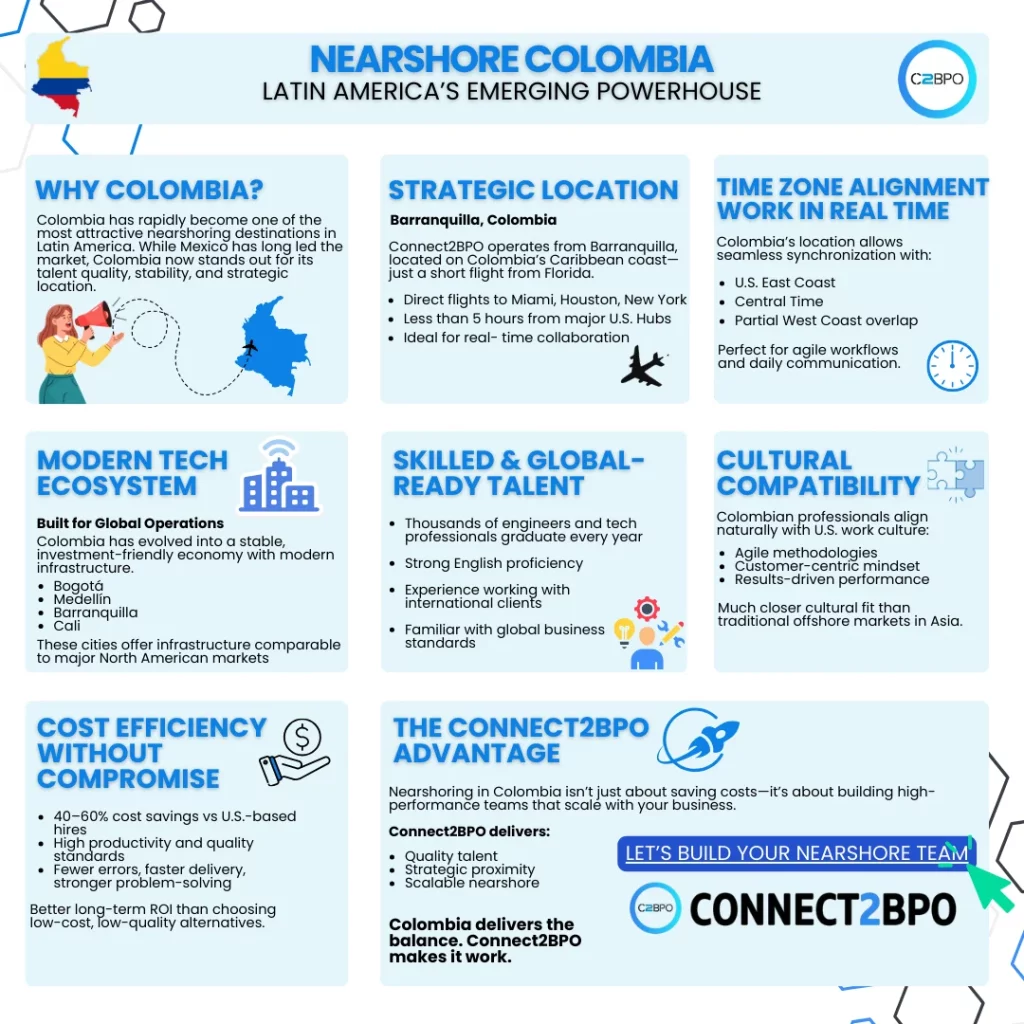
…the apparent offshore cost advantage largely disappears. Nearshore outsourcing to Colombia delivers 40–60% savings versus U.S. hiring, with the operational efficiency that keeps those savings from being consumed by hidden friction.
| Factor | Offshore (India/Philippines) | Nearshore (Colombia) |
|---|---|---|
| Time zone overlap with US | 0–2 hours | 8–10 hours |
| Cultural alignment | Low–Medium | High |
| English proficiency | Medium | High |
| Cost vs. US hiring | 50–70% savings | 40–60% savings |
| Travel to visit team | 20–30 hours | 3–5 hours |
| Communication friction | High | Low |
| Total cost of ownership | Often higher than expected | Predictable and competitive |
.
H-1B Visa Changes: Why US Companies Are Accelerating Nearshore Adoption
For years, the H-1B visa was the default answer for U.S. companies that needed international talent on-site. In 2026, that answer has become unreliable, expensive, and structurally broken for most businesses.
The H-1B Problem in 2026
H-1B visa fee increases have made sponsorship significantly more expensive. Between government filing fees, legal representation, premium processing, and internal compliance costs, companies routinely invest $10,000–$20,000+ per petition — before knowing whether the application will succeed.
The H-1B visa lottery system means even the most qualified candidates face lottery uncertainty. The cap is consistently oversubscribed, and approval is no longer something you can plan around. The H-1B visa reform proposals circulating in 2026 — including H-1B fee impact analyses from JPMorgan and others — suggest the financial burden will continue to rise.
Timeline delays are operationally crippling for businesses that need to move fast. From initial filing to final approval, the process spans months even under optimal conditions. For companies racing product deadlines or responding to market shifts, that lag is a competitive disadvantage.
The H-1B visa overhaul debate — including proposals tied to green card reform and concerns raised by governors like DeSantis — has made the policy environment unpredictable. Planning a talent strategy around a system this uncertain is an unnecessary risk.
When Is Nearshore Outsourcing the Better Choice?
Nearshore outsourcing addresses every H-1B pain point directly:
- No visa required — the talent stays in Colombia; you access their work remotely
- Onboarding in weeks, not months — Connect2BPO can have qualified professionals on your team in 2–4 weeks
- No lottery risk — hiring replaces uncertainty with a straightforward process
- 40–60% lower cost than a U.S.-based equivalent hire, without the compliance burden
For most roles that previously relied on H-1B sponsorship — software development, customer operations, data analytics, back-office functions — nearshore outsourcing delivers equivalent or superior outcomes at a fraction of the risk and cost.
Building a Full Remote Operation: What You Can Nearshore in 2026
This is where the conversation shifts. Most articles about nearshore outsourcing focus on software developers. Connect2BPO’s model is different — and more powerful. We help U.S. companies build entire remote operations in Colombia, not just add a few engineers to a Slack channel.
Here is what that looks like in practice:
Customer-Facing Operations
Customer Service Outsourcing — Bilingual agents trained on your brand, handling inbound and outbound interactions across voice, chat, and email. Contact Center Solutions built to scale with your business, with QA and performance reporting built in.
Sales Outsourcing — Sales Development Representatives (SDRs) handling outbound prospecting, lead qualification, and appointment setting. Nearshore sales teams give you pipeline support without the cost of expanding your U.S. sales floor.
Back-Office and Administrative Operations
Back Office Outsourcing — Data entry, document processing, administrative workflows, and operational support. The tasks that keep your business running but don’t need to happen in your headquarters.
Virtual Assistants — Dedicated professionals handling scheduling, research, inbox management, and executive support. Unlike freelance VA platforms, Connect2BPO VAs work exclusively for your business and are managed for performance.
Payroll Services — Accurate, compliant, multi-country payroll for LatAm teams, handled entirely by Connect2BPO. No need to build that infrastructure internally.
Technology and Knowledge Functions
Nearshore Software Development (Colombia) — Full-stack developers, mobile engineers, QA specialists, DevOps, and data engineers. Colombian developers are proficient across modern stacks — JavaScript, Python, Java, .NET, AWS, Azure, and more.
Data Annotation Services — Structured labeling, content moderation, and dataset validation for AI and machine learning pipelines. Nearshore annotation teams combine technical precision with on-site data security — something crowdsourcing platforms cannot match.
Digital Marketing Outsourcing — SEO, content production, paid media management, and social media. A nearshore marketing team gives you always-on execution without the overhead of a full in-house department.
Quality Analyst Services — Dedicated QA professionals monitoring performance, flagging gaps, and maintaining service standards across your operation.
Compliance and HR Infrastructure
Employer of Record (EOR) — Hire Colombian talent as formal employees — with full payroll, statutory benefits, and local labor law compliance — without opening a foreign legal entity. You direct the work; Connect2BPO handles everything behind the scenes.
Office Spaces in Colombia — For teams that need a professional, fully equipped physical environment, Connect2BPO provides facilities in Barranquilla where your nearshore operation can be based.
Why Colombia? The Nearshore Destination That Has Outpaced the Market
Colombia has transformed over the past two decades into Latin America’s most compelling nearshore destination. Here is why U.S. companies are choosing it — and why Connect2BPO is based there.
Talent Pool Depth
Colombia produces thousands of university-educated professionals annually in technology, business administration, marketing, finance, and engineering. Cities including Bogotá, Medellín, Barranquilla, and Cali each have developed distinct technology and business ecosystems, giving companies access to a broader and deeper talent pool than smaller markets can offer.
For software development specifically: Universities like Universidad de los Andes, Universidad Nacional, and EAFIT produce rigorous engineering graduates. Colombian developers are proficient in modern methodologies — Agile, Scrum, DevOps, CI/CD — and in cloud platforms including AWS, Azure, and Google Cloud.
English Proficiency
English proficiency among Colombian professionals in technology and business services has improved significantly. Most professionals in major tech and business hubs speak professional-level English, and Connect2BPO’s vetting process includes language assessment as a standard requirement.
Time Zone Alignment
Colombia operates on Eastern Time year-round (no daylight saving adjustment), which means consistent, predictable overlap with U.S. East Coast and Central teams. West Coast companies gain 6+ hours of shared workday — enough for full daily collaboration.
Cost Efficiency
This is where the business case for nearshore outsourcing to Colombia becomes undeniable. The numbers below are sourced from active market data — not projections.
| Role | Approx. Savings vs. U.S. Hire |
|---|---|
| Customer Service / BPO Agent | ~70–75% |
| Virtual Assistant | ~65–70% |
| Data Analyst | ~70–75% |
| Digital Marketing Specialist | ~65–70% |
| Sales Development Representative | ~65–70% |
| Software Developer (Junior–Mid) | ~55–65% |
| Software Developer (Senior) | ~45–55% |
Figures reflect bilingual professionals. EOR and management fees add ~15–25% above base — the savings above remain substantial even fully loaded.
The gap is most dramatic in customer-facing and operational roles, and narrows — though stays significant — at senior technical levels, where AI and cloud specializations command a regional premium. Colombia also sits at the lower end of the LatAm salary range: equivalent roles in Brazil, Mexico, and Argentina all run meaningfully higher, yet Colombia’s talent pool across technology, operations, and knowledge functions is among the deepest in the region. Best cost position, without sacrificing access to quality.
A few things worth noting about these numbers:
Colombia sits at the lower end of the LatAm salary range — meaningfully cheaper than Brazil, Mexico, and Argentina at comparable seniority levels, while carrying one of the deepest talent pools in the region. The gap is especially pronounced for customer service, back-office, and administrative roles, where Colombian professionals deliver 70–75% cost savings versus U.S. equivalents with no quality compromise.
For software development, the savings narrow at senior levels as AI-adjacent roles (Python, MLOps, LLM specialization) command a premium. Senior developers with AI or cloud specializations typically clear $70,000–$92,000 annually — still a 45–55% saving versus a U.S.-based equivalent.
Bilingual professionals — those with professional-level English — earn approximately 25% more than monolingual peers in the Colombian market, per Colombia’s Ministry of Labor. Connect2BPO’s vetting process screens for this as standard, which means the salaries above already reflect the bilingual premium you would actually pay.
What does a full nearshore operation actually cost?
A five-person team — the minimum Connect2BPO works with — covering customer service, back office, and a virtual assistant function would cost approximately $65,000–$100,000 per year in total compensation, including all Colombian employment costs. The U.S. equivalent of the same five roles would run $200,000–$250,000 in base salary alone, before benefits, payroll taxes, and overhead. The arithmetic is not subtle.
NetSourcing: Connect2BPO’s Transparent Outsourcing Model
Most BPO providers mark up labor with opaque margins. Connect2BPO developed NetSourcing — a hybrid between insourcing and outsourcing — to eliminate that problem. You pay the net salary of the talent, with no hidden fees or inflated margins. You maintain full operational control over your team. Connect2BPO handles all legal, payroll, and compliance infrastructure. The result: up to 50% cost reduction without sacrificing talent quality or management autonomy.
Colombia vs. Other Nearshore Destinations: Honest Comparisons
Nearshore Colombia vs. Costa Rica
Costa Rica was the early leader in nearshore BPO and still has strong infrastructure and political stability. But Colombia now outcompetes it on most practical dimensions: the talent pool is roughly 10x larger, costs run 15–25% lower for comparable roles, and multiple cities provide geographic redundancy. For companies scaling beyond a small team, Colombia’s deeper market is the stronger bet.
Nearshore Colombia vs. Mexico
Mexico’s proximity to the U.S. border and USMCA trade ties give it real advantages, particularly for manufacturing-adjacent industries and companies in border states. For technology and business process outsourcing, however, Colombian professionals generally have stronger English proficiency outside the top-tier hubs, and costs run 10–20% lower. For fully remote nearshore operations — where physical proximity is irrelevant — Colombia increasingly wins the comparison.
Nearshore Colombia vs. Brazil
Brazil has Latin America’s largest talent pool and most sophisticated domestic tech sector. The practical obstacles are well-known: Portuguese as the primary language creates integration friction, Brazil’s regulatory and tax complexity is among the highest in the region, and salary expectations in major tech hubs like São Paulo approach U.S.-adjacent levels. For most nearshore outsourcing use cases, Colombia’s combination of English fluency, simpler business environment, and cost predictability makes it the more practical choice.
Nearshore Colombia vs. Argentina
Argentina produces excellent technical talent — particularly in fintech, data science, and complex engineering — and Argentine developers have a well-earned global reputation. The challenge is economic: currency volatility and inflation cycles make long-term budgeting difficult and can erode the predictability that nearshore outsourcing is supposed to provide. Colombia’s relative macroeconomic stability makes it the more reliable foundation for a long-term remote operation.
Nearshore Colombia vs. Peru
Peru is an emerging nearshore market with a growing tech sector and competitive costs. The gap with Colombia is primarily in talent pool maturity, English proficiency levels, and business infrastructure depth. For companies entering nearshore outsourcing for the first time and wanting a developed ecosystem with proven track record, Colombia is the lower-risk starting point.
How to Build Your Nearshore Operation: A Practical Roadmap
Step 1: Define What You’re Outsourcing (and What You’re Not)
The most successful nearshore operations start with clarity. Which functions are truly non-core, or which need scale that’s impossible to build domestically? Which roles require deep company-specific knowledge that makes outsourcing impractical? Map your organization honestly before engaging any provider.
High-value candidates for nearshoring: customer service, back office, sales development, software development, digital marketing, data operations, administrative support.
Step 2: Choose Your Model
- Staff augmentation — individual professionals added to your existing team, working under your management
- Dedicated team — a managed unit working exclusively on your operations, with Connect2BPO handling HR and compliance
- EOR employment — formal employment of LatAm talent through Connect2BPO as legal employer, with full statutory benefits and compliance
- Full BPO — complete process ownership, where Connect2BPO manages the people and the outcomes
Most companies start with staff augmentation or a small dedicated team and scale toward EOR employment as the relationship matures.
Step 3: Select Your Nearshore Partner
The provider decision matters more than the country decision. Evaluate on:
- Talent vetting process — how do they screen for technical skills, English proficiency, and cultural fit?
- Compliance infrastructure — do they genuinely handle Colombian labor law, payroll, benefits, and taxes?
- Transparency — are costs clear and predictable, or buried in margins? (See: NetSourcing)
- Track record — how long have they operated, and can they provide references from companies similar to yours?
- Scalability — can they staff one person or fifty, and how fast?
Connect2BPO has been building nearshore teams in Colombia since 2016. The minimum team size is five members, which ensures operational efficiency and a solid support structure from day one.
Step 4: Onboard for Integration, Not Just Productivity
The biggest failure mode in nearshore outsourcing is treating the remote team as a vendor rather than an extension of your company. The teams that perform best are those that go through real onboarding: access to your tools, training on your processes, introductions to their U.S. counterparts, and clear performance expectations from week one.
Step 5: Measure and Scale
Define KPIs before you start. Review performance at 30, 60, and 90 days. If the model is working — and with the right partner, it will — scale confidently. The entire point of nearshore outsourcing is elastic capacity: you can grow the team without the friction of domestic hiring.
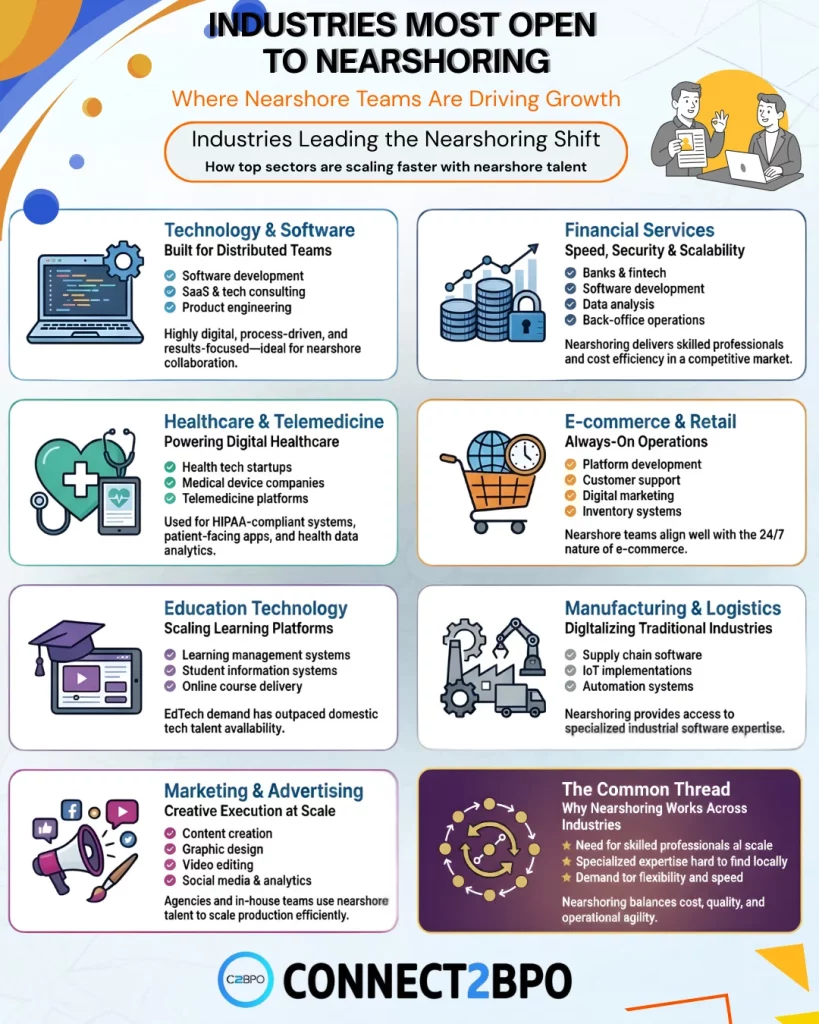
Industries Leading Nearshore Outsourcing Adoption in 2026
Technology and SaaS — Software development, QA, DevOps, technical support. The original nearshore use case, and still the largest segment.
Healthcare — Healthcare BPO including medical billing, patient communication, and back-office administration. HIPAA-aware teams built for compliance-sensitive environments.
Insurance and Financial Services — Insurance BPO and Health Insurance BPO handling claims processing, policy administration, and member services at scale.
Legal Services — Legal Process Outsourcing (LPO) for document review, contract management, and paralegal support. Nearshore LPO has grown rapidly as law firms and in-house legal teams face staffing pressure.
Real Estate — Real Estate Outsourcing covering transaction coordination, listing management, CRM management, and lead follow-up. Nearshore real estate VAs have become standard for high-volume agents and brokerages.
E-commerce and Retail — Customer support, order management, digital marketing, and data entry. The 24/7 nature of online retail aligns naturally with nearshore team structures.
AI and Machine Learning — Data annotation, content moderation, and HITL (human-in-the-loop) review. Nearshore annotation teams combine the cost efficiency of outsourcing with the security and quality control that enterprise AI projects require.
Frequently Asked Questions
What is nearshore outsourcing?
Nearshore outsourcing means partnering with service providers in nearby countries — for U.S. companies, primarily Latin America — to handle business operations, technology development, or specialized functions. The key advantages over offshoring are time zone alignment, cultural compatibility, and communication quality. Unlike offshore providers, nearshore teams operate during your business hours and integrate more naturally with your in-house team.
When is nearshore outsourcing the better choice over offshore?
Nearshore outsourcing outperforms offshore in any situation where real-time collaboration, communication quality, or cultural alignment matters. That includes: agile software development, customer-facing roles, knowledge-intensive back-office functions, and any operation where your team needs to interact daily with the outsourced professionals. Offshore may retain a slight edge on raw hourly rates for highly commoditized, asynchronous work — but for most functions, nearshore total cost of ownership is lower.
What is nearshore software development?
Nearshore software development is building engineering teams — developers, QA engineers, DevOps, architects — in nearby countries that share your time zone. Colombian software development teams are particularly sought after in 2026 for their combination of technical skill, English proficiency, and real-time collaboration capability. Connect2BPO sources and manages nearshore software development professionals across all major technology stacks.
Which companies offer the best nearshore staffing with payroll handling?
The best nearshore staffing providers combine three things: strong talent acquisition pipelines, comprehensive payroll and legal compliance management, and transparent pricing. Connect2BPO’s NetSourcing model is specifically designed to address the opacity problem in BPO — you pay the talent’s net salary with no hidden margins, while Connect2BPO manages all Colombian labor law compliance, payroll, and benefits. Employer of Record services add formal employment infrastructure for companies that want to give their nearshore team full employment status.
Which nearshore staffing firm is best for scaling engineering teams fast?
Fast ramp-up depends on the provider’s active talent pipeline and their ability to vet candidates at speed without sacrificing quality. Connect2BPO can assemble and onboard most teams within 2–4 weeks. The minimum team size of five ensures a proper support structure from day one, and the ability to scale across Bogotá, Medellín, Barranquilla, and beyond means geography is rarely a bottleneck.
Where can I find nearshore AI engineering talent?
Colombia is an increasingly strong source of nearshore AI and machine learning talent. Universities are producing data scientists and ML engineers at scale, and the professional development community in Bogotá and Medellín has embraced AI tooling and frameworks. Connect2BPO sources AI engineering talent for roles including data engineering, ML model development, data annotation and training data management, and AI-augmented customer operations.
What is the difference between nearshore outsourcing and an Employer of Record?
Nearshore outsourcing refers broadly to any arrangement where a provider manages remote talent in a nearby country on your behalf. An Employer of Record (EOR) is a specific legal structure: the EOR becomes the formal employer of your LatAm workers, handling payroll, taxes, benefits, and labor law compliance, while you retain full operational control. EOR is the right model when you want to formalize an ongoing relationship, offer full employment benefits, or mitigate contractor misclassification risk. Many companies start with nearshore staff augmentation and transition to EOR employment as relationships mature.
Ready to Build Your Remote Operation in Colombia?
The case for nearshore outsourcing in 2026 is not marginal — it is structural. H-1B visa uncertainty, rising domestic hiring costs, and the proven track record of LatAm talent have made Colombia the default answer for U.S. companies that want the efficiency of a distributed team without the friction of traditional offshoring.
Connect2BPO has been building those teams since 2016. We recruit, hire, manage, and retain professionals across every function — from customer service and sales to software development, back office, and data operations — with full payroll, legal compliance, and HR infrastructure included.
You focus on managing your team’s work. We handle everything else.
Contact Connect2BPO to discuss your nearshore operation. Most teams are ready to launch within 2–4 weeks.