Human resources has evolved from simple personnel management into a strategic business function that shapes organizational culture, drives performance, and ensures companies can attract, develop, and retain the talent they need to succeed. This article explores HR from broad foundational concepts down to the specific activities and benefits that vary across industries.
Check this complete glossary of HR concepts and terms
Foundational Concepts
Human Resources (HR) refers to both the people who work for an organization and the department responsible for managing all aspects of the employee lifecycle. Modern HR serves as a bridge between management and employees, handling everything from recruitment to retirement.
Human Capital is the economic value that employees bring to an organization through their knowledge, skills, experience, and capabilities. This concept frames employees as assets requiring investment rather than simply costs to be minimized.
Talent Management encompasses the integrated processes of recruiting, developing, retaining, and optimizing an organization’s workforce to meet current and future business needs.
Core HR Functions
Human Resource Management encompasses the strategic and operational activities required to manage an organization’s workforce effectively. Modern human resource systems integrate these functions into cohesive platforms that streamline processes, improve data accuracy, and provide insights for better decision-making.
Recruitment and Selection involves identifying workforce needs, attracting qualified candidates, and choosing the best fit for positions. This includes job analysis, posting positions, screening applications, conducting interviews, and making hiring decisions.
Onboarding is the process of integrating new employees into the organization, covering everything from paperwork completion to cultural assimilation and initial training. Effective onboarding significantly impacts employee retention and productivity.
Performance Management refers to continuous processes of setting expectations, monitoring progress, providing feedback, and evaluating employee performance. This includes performance appraisals, goal setting, and development planning.
Learning and Development (L&D) encompasses training programs, skill development initiatives, leadership development, and career pathing designed to enhance employee capabilities and prepare them for future roles.
Compensation and Benefits involves designing and administering pay structures, bonuses, health insurance, retirement plans, and other rewards that attract and retain employees while controlling costs.
Employee Relations focuses on maintaining positive relationships between employers and employees, addressing workplace conflicts, ensuring fair treatment, and fostering engagement and satisfaction.
Strategic Human Resource Management aligns HR practices with overall business objectives, ensuring that workforce capabilities support long-term organizational goals. This approach treats HR as a strategic partner rather than just an administrative function, using data-driven insights to inform decisions about talent acquisition, development, and retention.
Compliance and Legal ensures the organization adheres to employment laws, labor regulations, workplace safety standards, and anti-discrimination requirements that vary by jurisdiction. Navigating these complexities becomes particularly challenging when companies expand internationally or hire remote workers across different countries.
This is where Employer of Record (EOR) services provide invaluable support.
Connect2BPO offers comprehensive EOR solutions that handle all legal and compliance responsibilities for your international workforce, allowing you to hire talent in Colombia and other markets without establishing a local entity. Our services manage everything from employment contracts and payroll processing to tax withholding, social security contributions, and adherence to local labor laws, eliminating the risk of non-compliance while you focus on growing your business.
With Connect2BPO as your trusted partner, global expansion becomes streamlined, cost-effective, and compliant.

Strategic HR Activities
Workforce Planning involves forecasting future staffing needs based on business strategy, analyzing current workforce capabilities, and developing plans to address gaps through recruitment, training, or restructuring.
Organizational Development (OD) focuses on improving organizational effectiveness through planned interventions in processes, culture, and structure. This includes change management, culture transformation, and team development.
Succession Planning identifies and develops internal candidates to fill key leadership positions when they become vacant, ensuring business continuity and reducing external hiring costs.
Employee Engagement measures and improves the emotional commitment employees have to their organization and its goals, recognizing that engaged employees are more productive, innovative, and likely to stay.
Diversity, Equity, and Inclusion (DEI) initiatives work to create fair, respectful workplaces where diverse perspectives are valued and all employees have equal opportunities to succeed.
Common Benefits Across Industries
Health and Wellness Benefits typically include medical, dental, and vision insurance, along with wellness programs, mental health support, and employee assistance programs (EAPs) that provide counseling services.
Retirement Benefits most commonly include 401(k) plans or pension programs, often with employer matching contributions to help employees build long-term financial security.
Paid Time Off (PTO) encompasses vacation days, sick leave, personal days, and holidays. Some organizations are moving toward unlimited or flexible PTO policies.
Work-Life Balance Programs include flexible scheduling, remote work options, parental leave, childcare assistance, and eldercare support that help employees manage personal responsibilities.
Professional Development benefits cover tuition reimbursement, conference attendance, certification programs, and internal training opportunities that enhance employee skills.
Industry-Specific HR Characteristics
Technology Sector: HR in tech companies often emphasizes competitive compensation with stock options and equity, unlimited PTO, cutting-edge office amenities, and rapid career advancement opportunities. The focus is on attracting top talent in competitive markets, with benefits like free meals, gym memberships, and learning stipends. Recruitment heavily emphasizes technical skills assessment and cultural fit with innovation-driven environments.
Healthcare Industry: HR faces unique challenges with 24/7 staffing requirements, credentialing and licensing compliance, and high burnout rates. Benefits often include shift differentials, continuing education support for maintaining certifications, robust mental health resources, and loan forgiveness programs for nurses and physicians. Employee wellness is paramount given the emotionally demanding nature of patient care.
Manufacturing: Safety training and compliance dominate HR activities, with emphasis on OSHA regulations and workplace injury prevention. Benefits often include union-negotiated packages with strong pension plans and seniority-based advancement. Shift work is common, requiring careful scheduling and shift premium pay. Training focuses heavily on technical skills and equipment operation.
Retail and Hospitality: These industries face high turnover rates, seasonal staffing needs, and often employ part-time or hourly workers. HR focuses on efficient onboarding processes, flexible scheduling systems, and employee discount programs. Benefits may be limited for part-time staff, though larger retailers increasingly offer health insurance and tuition assistance to attract workers in tight labor markets.
Financial Services: Compliance and regulatory training are extensive due to strict industry oversight. Compensation often includes significant bonus structures and incentive programs. Background checks and ongoing ethics training are rigorous. Benefits tend to be comprehensive, with strong retirement programs and professional development focused on certifications like CFA or CFP.
Education: HR in schools and universities manages both academic and administrative staff with different career tracks. Benefits often include tuition waivers for employees and dependents, generous vacation schedules aligned with academic calendars, and pension plans. Tenure processes create unique performance management challenges, and summer employment patterns require creative benefits planning.
Nonprofit Sector: Organizations operate with budget constraints that affect compensation levels, so HR emphasizes mission-driven recruitment to attract passionate employees. Benefits may include student loan forgiveness programs (especially for public service roles), flexible schedules, and generous PTO. Professional development often focuses on grant writing, fundraising, and program management skills.
Emerging HR Trends
People Analytics uses data and statistical methods to inform HR decisions about hiring, retention, performance, and organizational effectiveness, moving HR toward evidence-based practices.
Employee Experience (EX) design applies principles from customer experience to create positive, meaningful employee journeys from recruitment through exit, recognizing that employee satisfaction drives business outcomes.
Gig Economy and Contingent Workforce Management addresses the growing use of freelancers, contractors, and temporary workers, requiring new approaches to workforce planning, benefits, and compliance.
HR Technology (HR Tech) includes applicant tracking systems, human resource information systems (HRIS), learning management systems (LMS), and AI-powered tools that automate routine tasks and provide insights.
The field of human resources continues evolving as workforce demographics shift, technology advances, and employee expectations change. Successful HR professionals balance strategic business thinking with genuine care for employee wellbeing, recognizing that an organization’s people remain its most valuable asset regardless of industry.
Human Resources KPIs (Read the complete guide)
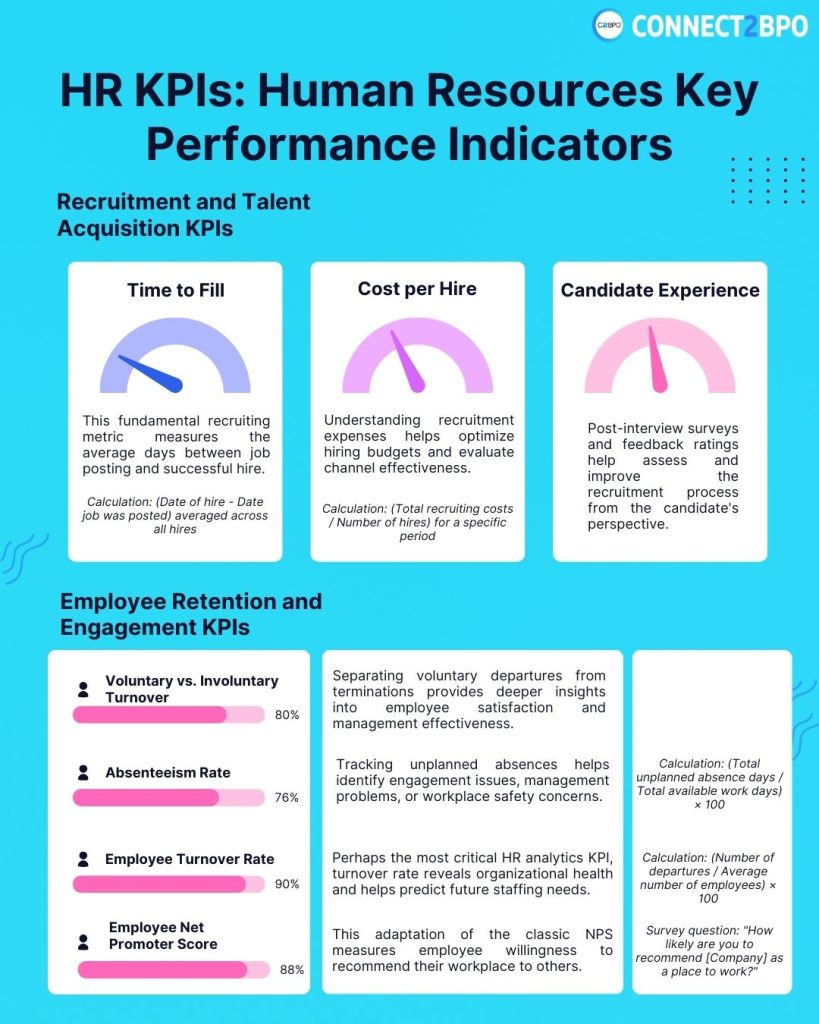
HR KPis are quantifiable metrics that measure the effectiveness and efficiency of HR initiatives and overall workforce performance. These critical indicators help organizations track progress toward strategic goals, identify areas for improvement, and demonstrate HR’s value to the business. Common HR KPIs include time-to-hire, cost-per-hire, employee turnover rate, retention rate, absenteeism rate, training effectiveness, employee satisfaction scores, and return on investment for HR programs. By monitoring these metrics through dashboards and regular reporting, HR leaders can make data-driven decisions about resource allocation, identify trends before they become problems, and align workforce strategies with business objectives. Effective use of Human Resources KPIs transforms HR from a reactive administrative function into a proactive strategic partner that drives organizational success.
Simplify Your HR with Connect2BPO
Expanding globally? Building your team? Connect2BPO delivers complete HR solutions tailored to your needs.
We provide:
- Employer of Record Services: Hire in Colombia without establishing local entities. We handle compliance, payroll, and benefits in Colombia.
- Staffing Solutions: Access pre-vetted talent for temporary or permanent positions across all industries.
- Recruitment Services: Find the perfect candidates who match your technical needs and company culture.
Ready to streamline your talent strategy? Contact Connect2BPO today and let us handle the complexity while you focus on growth.